
Francesco Carone: Nevermore
Solo Show
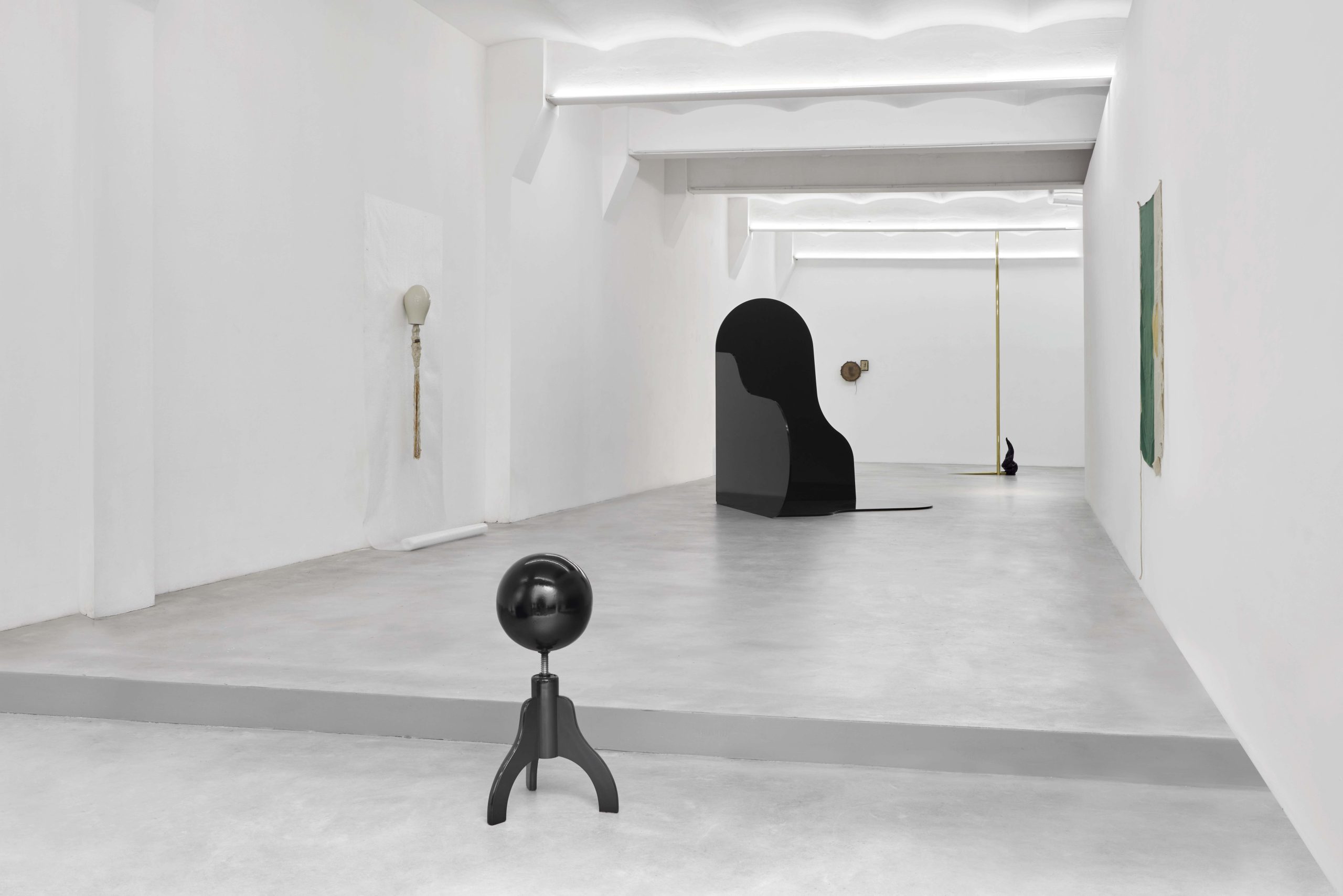
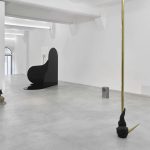
A black mark looms at the center of the gallery, shiny, precise in its contours. It is a sort of self-sufficient piece of architecture, a hard flower with just three stiff, very smooth petals. A mysterious but hospitable hollow, an elegant shelter, like the three grand pianos whose lids have been used to assemble it. Nevermore is the title, which starting from this piece radiates through the entire show, like an entreaty or a regret, caroming amidst the walls, propagating endlessly.
“Nevermore” (an expression that has faded from use in English) is the single, repeated response which the protagonist of the poem The Raven receives during an unexpected nocturnal visitation, when the bird knocks on his door. Published in 1845 by Edgar Allan Poe, the poem narrates a rhythmical, surreal dialogue between what the writer calls an “ebony bird” and a man with a sad fancy imagination: to the questions of the latter about the possibility of embracing anew his beloved and deceased Lenore, the raven always responds simply with a repeated, desolate and blunt “nevermore,” monotonous as a parrot that had somehow donned a raiment of darkness.
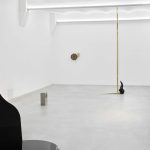
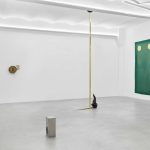
Starting from this gothic allegory that, like a warning or a litany, marks the passage of time in its deeper nature of definitive, irreparable loss, Francesco Carone constructs an exhibition with a sheltered atmosphere, such as that of a home. An interior brightened by a nocturnal glow, where Carone gathers a few objects, some of them fabricated, others obtained by salvaging and manipulating abandoned things, like the frayed cloth that once covered a pool table, now enhanced with gold leaf (Deposizione, Mond); an Italian flag that has flown until it has lost its red, now endowed with an unknown symbolism (E fu sera e fu mattina); a stool no longer useful, at least not for sitting on the black sphere above it (Bulbo). Carone seems to approach these objects with a sort of tenacity that is as therapeutic as it is poetic, responding to an impulse for which art, above all contemporary art, seems often to be endowed, namely that of rescuing things from their otherwise fated oblivion. With their semi-environmental scale, other works almost have the function of spatial coordinates for this solitary, dispersed domestic interior: we can imagine nestling inside the partial architecture embodied by Nevermore, almost as if it were a study deprived of the consolations of philosophy, or to seek a warmth we will never find, gravitating around a fixed, dark flame set at the foot of a brass pole that defines the height of the space (Prometeo). A cement volume (Cura della follia) on the ground seems to suggest the familiar presence of a stereo speaker, if not for the fact that it too is silent and inert, like the material that paralyzes the vibrations. Only closer observation allows us to notice how the physiognomy of this silent “instrument” has been produced through sculptural excavation, not technological assembly: the form of a funnel in this cement block has etched the imprint of an opening that emits no sound, just as the lids of the pianos in Nevermore will never vibrate with melodies again. There is a sole, weakly anthropomorphic presence that dwells in this habitation unit otherwise destined to have the shaken, vigilant sensibility of an insomniac, who paces and retraces the same corridor in search of a foothold, scouring the walls in an attempt to break free of them: it is a ceramic head that drags, like a tail, an eroded rope (Sirena, Scia); it is an ambiguously mythological presence that thrashes between the features of a closet mermaid and an artisanal medusa, set like a relic on plastic wallpaper of air bubbles and pearls. A material – commonly known as “bubblewrap” – with which we protect delicate things for storage or transport. A material that indicates transition, a covering that signals an abandonment – for the moment or forever, as the case may be – which we find here spread out as wall decoration, as if the entire spatial situation had been robed in fragility itself.
Francesco Carone seems to project his “sad fancy” imagination onto the parts of a domestic interior that keep each other company, without inviting us inside; objects that if questioned seem to offer the same reiterated response to the doubts we raise, with the same persistence as Poe’s “ebony bird”. The theater of this questioning about the end of things is a domestic stage, though the remnants of its composition are ignited by an imagination that is surreal at times, a solitary, nocturnal, haunting imagination. There are moments when as we observe the most prosaic and quotidian things around us, we can glimpse our end inside their own. There are some, like artists and poets, who manage to give form to this anguish, and for them that instant of realization becomes a metamorphic and imaginative field, in which things go beyond their own appearances. Most of us, on the other hand, fall quiet within that instant, as do things with us, unable to escape. The memory of the last verses of Cesare Pavese resurfaces (“We’ll go down into the vortex in silence”), the final image – transformative and thus redeeming – that concludes Death Will Come with Your Eyes, that of the drain in the bathroom sink that becomes the entrance to Hades.